


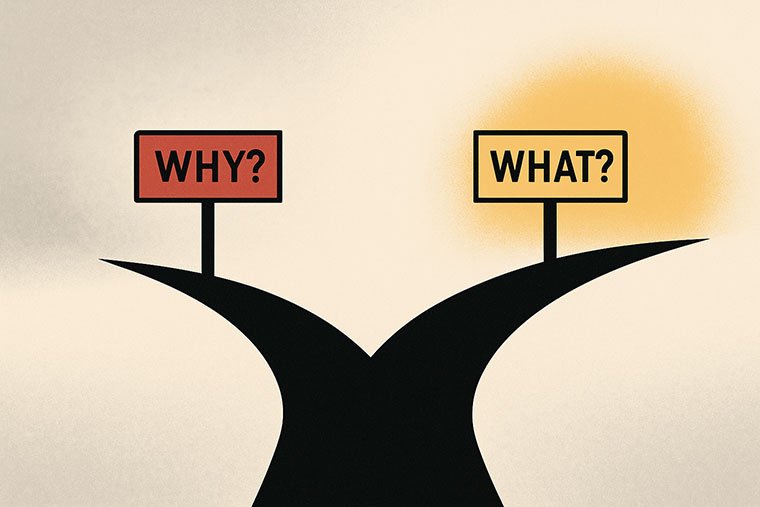
“Why did you do that?”
Five words that can mean, “I’m curious” or “I’m coming for you.”
We’ve all heard it. We’ve all said it. Sometimes it’s a genuine question. Sometimes it’s code for “You better have a good explanation.”
“Why” is supposed to lead us to understanding. But more often than we realize, it triggers something else entirely — defensiveness, justification, maybe even blame.
And I’m not talking about tone. I’m talking about the substance of the word ‘why’ and how it impacts us and how it can actually lead us away from the truth.
Let’s start with some simple situations:
Situation #1: Curious Kid, Clear Skies
It’s a lazy, sunny Sunday afternoon. My five-year-old and I are out for a bike ride. We stop briefly, and he looks up and asks, “Why is the sky blue?”
I smile; his curiosity is charming. I explain that it has to do with how light scatters in the atmosphere, and, since I’m no scientist, I promise we’ll look up a more complete answer when we get home.
He nods, content. We hop back on our bikes and keep riding.
Situation #2: Time to Go
A few weeks later, we’re wrapping up a visit with friends. The kids have been playing for hours, and it’s time to leave. My son asks, “Why do we have to go?”
This time, my reaction is different. The smile is gone. We’ve been guests for several hours, it’s getting late, and leaving is the obvious next step. But now I feel like I’m being challenged. He’s not just asking a question—he’s asking me to defend a decision.
What was curiosity in the first scenario feels like resistance in the second.
Same Word, Different Feelings
Same child. Same question word. Two very different reactions.
In the first situation, there was nothing personal—no decision to defend, no ego involved. I didn’t create the sky or control its color, so I felt no need to justify anything.
In the second, I had made a call—and now I was being asked to explain it. The “why” triggered defensiveness. I didn’t feel invited into curiosity—I felt cornered.
The point is this: the same word—“why”—can trigger very different emotions depending on the context. And that emotional undercurrent can shape whether a conversation becomes collaborative… or confrontational.
Why at Work…
Of course, we don’t leave “why” behind when we leave the house. It follows us into meetings, emails, retrospectives and all the moments where stakes are high and emotions are close to the surface.
In fact, years ago, Toyota went a step further and created the “5 Whys”, a method to uncover the root cause of a problem by asking “why” five times. The method was brilliant in its simplicity: just keep digging until you find the foundational issue, not just the surface-level symptom. We can certainly learn a lot by seeking out the root cause of a problem. Getting to the bottom of things should absolutely be the goal.
But here’s the twist: if we want real insight, the word “why” might actually be getting in the way.
A Quick Caveat Disclaimer
Note that I’m not here to cancel “why”. But I’ve been in too many situations when even a good meaning “why” doesn’t yield the outcome I was seeking. Let’s explore this further.
When (and Why) we use “Why”
We know “why” is a powerful word. It’s direct. It signals urgency and intent. We need an answer, now!
But, especially in high-stakes or emotionally charged situations, “why” can easily provoke a defensive reaction. “Why” triggers our fight or flight mentality. We frantically look to explain our decisions, protect ourselves and avoid blame.
Picture this: Your web-based application crashes. Customers can’t access the system. Support tickets flood in, customers are screaming, Slack is melting down and employees are frantic. Eventually, the situation is rectified and calm returns. Naturally, we want to know “WHY” – “WHY did this happen?”
Using the 5 Why’s method, we gather and hold a retrospective, and we start a discussion:
VP: Why did the website go down?
Manager: There was a lack of memory.
VP: Why did the server run out of memory?
Manager: A background job started consuming all available resources.
VP: Why was the background job using so much memory?
Manager: It was accidentally running an infinite loop.
VP: Why did the job contain an infinite loop?
Manager: The logic wasn’t properly tested before deployment.
VP: Why wasn’t the logic properly tested?
Manager: We skipped the code review to meet the sprint deadline.
Candidly, if I was hearing these responses, I’d be angry. I’d assume someone was careless or maybe even incompetent. I mean, why would we skip a code review? I would want to find someone to blame (i.e., maybe someone’s getting fired).
And, if I were giving these responses? Honestly, I’d be terrified. I certainly wouldn’t feel objective or open – I’d feel interrogated. I’d be focused on surviving the conversation, not solving the problem. Maybe even, er… trying to deflect blame just to protect myself.
Sound familiar?
Reframe Blame to Discovery
What are we truly trying to determine with our questions? Ultimately, we want to understand whether this situation can be avoided in the future. To do that, we need discovery, not combat.
As such, rather than using “why”, consider “what”. “What” asks for details or specifics and often better engages our curiosity and invites us to share information or other clarifying views. Overall, a “what” question can make the conversation more neutral and open to discovery and not blame.
Same situation as before, but we’ve replaced “why” with “what” questions:
VP: What caused the website to go down?
Manager: There was a lack of memory.
VP: What contributed to the lack of memory?
Manager: A background job that was running got stuck in an infinite loop.
VP: What led to the loop?
Manager: There was an edge case that wasn’t caught in our testing before deployment.
VP: What was different about this deployment?
Manager: We were short a team member and the code was pushed out without our usual rigorous testing.
VP: What other factors contributed?
Manager: We had a tight deadline and we were balancing a new set of responsibilities for another product line.
Notice a difference? Did we feel different? Did we learn more?
As the one asking the questions, using “what” made me feel more curious and more open to an honest response. I wasn’t seeking blame; I was seeking an understanding. Afterward, instead of looking for someone to fire (or chastise), I would want to know how I can help the team avoid these situations in the future (more personnel, better prioritization, etc.)
And, if I was responding, I challenged myself for more insight, more thought and to dig even further. I didn’t feel attacked nor defensive. I was open to finding more factors that contributed to the website crashing.
From “Why” to Better Discovery: Reframing Examples
To keep the concept in mind, here are some additional everyday examples that might be helpful. In these examples, which version do we think would yield a better understanding?
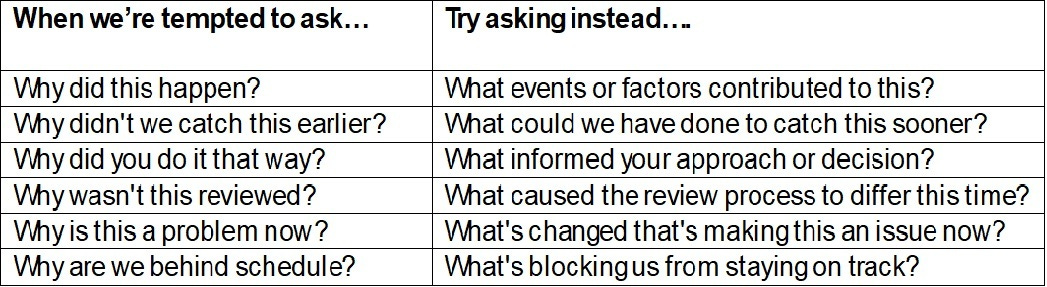
This isn’t about sugarcoating hard conversations. It’s about getting real answers—without shutting people down.
Key Takeaway
If we’re truly seeking real discovery, maybe it’s time we stop asking “why”—and start asking “what.”
The right question doesn’t just uncover better answers. It makes people feel safe enough to give them.
Coming Soon – When “Why” is the Right Move
There are absolutely moments when “why” is the right question—and I’ll share some thoughts on that in a future post.
But for now, the next time you’re looking for answers, try starting with “what.”
You might be surprised by what you learn.
