


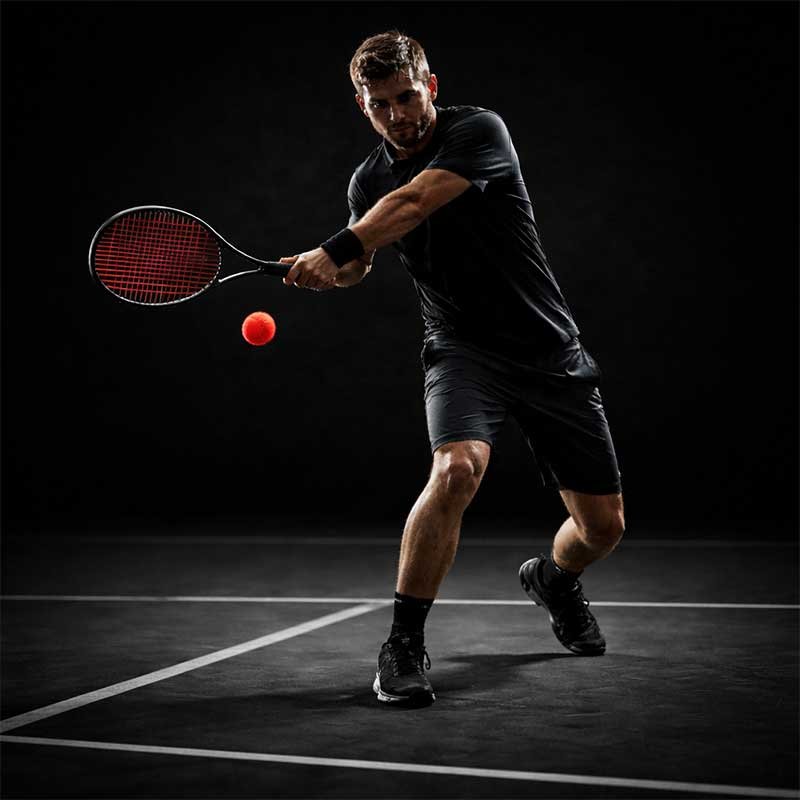
Championship point.
Sweat rolled down his face the moment he wiped it away.
Over three hours on the court.
The match had been brutal. Now, just one point stood between him and the win.
His opponent wasn’t going down easy. They both wanted it. Badly.
The rally began.
Back and forth.
The crowd leaned in.
Then, he saw his chance.
A ball came slower, softer…
This was it.
But the ball was too close to his body…
The Lesson: Create Space
For the last few years, I’ve been playing more tennis.
More recently, I’ve been actively working to get better.
My swing felt unnatural and a little trapped.
So, I started taking lessons (Thanks, Joe!).
My key breakthrough was this: Create space.
I was swinging with my body too close to the ball.
And I couldn’t swing freely.
My motion was tight, unnatural…restricted.
The result: inconsistency with a lack of power and accuracy.
I realized I wasn’t alone either.
Many amateur players do the same.
Coaches yell “move your feet,” but what they really mean is: create space.
We rush to get to the ball, but we get too close and jam ourselves up.
But, to hit cleanly, we need space.
Business Works the Same Way
The more I thought about it, the more I saw the same thing in work.
We pack our calendars, work to instantly respond to every request, and feel accomplished when every email is no longer “unread”.
We are hustling, but are we giving ourselves the space to hit cleanly?
Are we giving ourselves room to swing freely?; or
Do we overrun the target and get jammed?
Space Creates Flow
Years ago, psychologist Mihaly Csikszentmihalyi introduced a concept known as flow.
Flow is a mental state where a person is so fully absorbed in an activity, everything clicks. Time feels suspended. Judgment sharpens.
And we are free to do our best thinking without forcing it.
But flow doesn’t show up when we’re jammed.
It doesn’t live in back-to-back meetings or constant context switching. It needs room.
Studies show it takes at least 20–30 minutes of uninterrupted focus to enter flow.
One email ping — one Slack message — and it’s gone.
You don’t just “pick it back up.” It takes another 20 minutes, if it comes back at all.
Flow needs space.
And most of us are running out of it.
Clarity Takes Distance
Intrinsically, we know this.
Nonetheless, it’s a concept that needs a consistent reminder.
Six+ months ago, I stepped away from day-to-day operations.
No calendar full of back-to-backs. No fire drills. No constant motion.
And something surprising happened:
I started to see more clearly.
I’ve been able to be more objective.
Better understand blind spots that were, by definition, previously invisible to me.
I can view where shortfalls existed.
Moreover, I can better identify where new opportunities can rise.
All it took was space.
So What Do We Do?
I know not everyone can step away for long periods of time.
That doesn’t mean space is unachievable.
We just need to know where to look and consciously create it.
A few suggestions:
- Block “space” on your calendar AND protect it
Don’t just schedule time with no commitment. Treat the time as a priority (e.g., meeting with your boss, your best client, etc.) No rescheduling or last-minute changes. Give this time the same respect we give important work (because it is).
- Delegate with purpose
If we are the gatekeepers for everything, we will never find space. I recently spoke with a CEO that did just this and with great success. More time for strategy and actions that will drive the business forward vs just surviving.
- Build transitions into your day
Constant switching kills clarity. Leave 15-30 minutes between important conversations or tasks. This is not wasted time. Our brains need time to reset and start thinking independently again.
Our best work, the kind that changes things, doesn’t come when we’re crammed up against the ball.
It comes when we give ourselves the room to move. To think. To swing freely.
And that’s the lesson I keep coming back to.
If we want to be precise, powerful, and clear: create space.
Championship Point
That championship point?
He didn’t freeze.
He adjusted.
He created the space.
He swung freely and struck it clean.
Trophy in hand.
Key Takeaways (TL;DR)
To do our best thinking, we need space (just like in tennis).
We already know this, but we rarely prioritize and protect the time.
Block your calendars and silence your phones.
Prioritize your thinking time.
Live in this space. And swing freely.
Try This
If things feel tight, rushed, reactive, unclear, let’s ask ourselves:
- Where am I crowding the ball?
- What decision, conversation, or idea needs more room?
- Where can I step back, just a little, to swing more freely?
That space doesn’t have to be dramatic.
It might be 30 minutes of focused thinking.
A walk.
A pause before reacting.
A day off the field to see the game better.
The point isn’t to slow down for the sake of it.
It’s to move with intention — and leave room to hit clean.
Because if we always play jammed, we’ll always swing tight.
And we’ll keep wondering why we miss the shots.
