


Most people think conflict comes from personality clashes.
It doesn’t.
I’ve seen the biggest blowups happen when people actually share the same goal.
Researchers back this up. In Getting to Yes, authors Roger Fisher and William Ury explained that conflict isn’t really about stated positions, it’s about the underlying interests people rarely say out loud.
Those hidden priorities are what drive tension.
And Elias Porter, a psychologist who studied conflict for decades, found that when pressure rises, our default instinct is self-preservation.
We protect our own standing first, even if it works against the team.
On the Court
I play a lot of doubles tennis.
At the start of every match, my partner and I have the same goal: win the match.
That should mean no conflict — right?
It rarely works that way.
I’ve seen the subtle signs such as an eye roll after a missed shot, a partner shaking their head, even an angry outburst.
I have to admit I’ve done the same myself.
And I catch myself thinking:
- Aren’t they trying to win?
- Why don’t they care as much as I do?
- Maybe they’re just not that good.
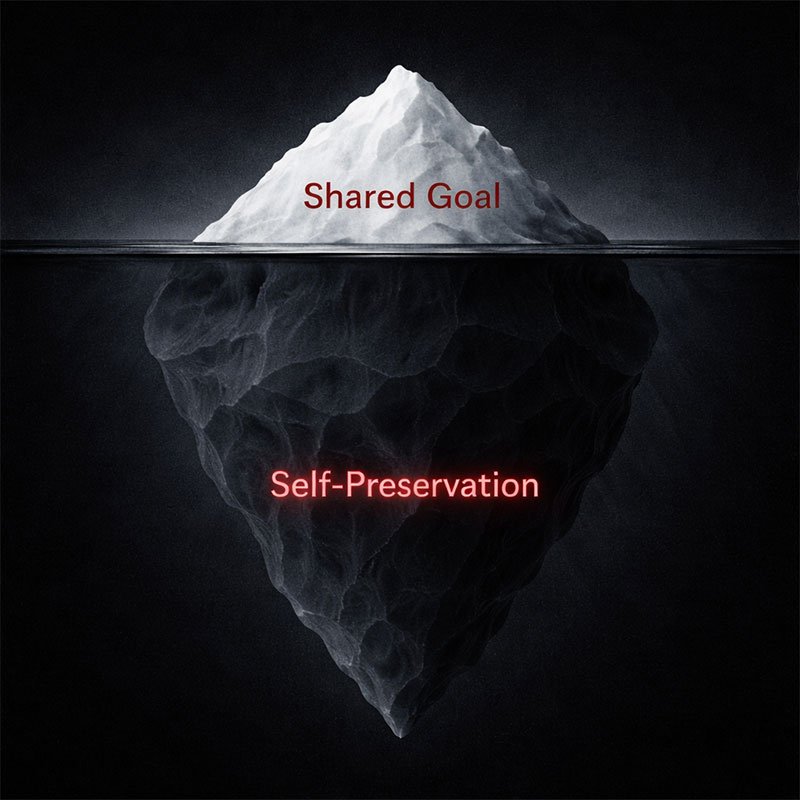
On the surface, our goal is shared.
But under the surface, another set of priorities is running.
My reputation. My desire to look competent. My self-worth.
These hidden priorities hijack the stated goal. And suddenly, we’re in conflict.
At Work
The same thing plays out in business.
Take a team working to release a new software feature this quarter. Everyone’s aligned on the stated goal (at least on paper). But one developer is evaluated on how quickly code gets written, while another is evaluated on minimizing bugs.
Both want the release to succeed. Both care about the team goal. But the hidden priorities baked into how they’re measured (speed vs. quality) guarantee tension.
And it shows up at the executive level too.
In one meeting, a sales leader defended closing a big account by promising features the client demanded. His priority: win the deal and show growth. Across the table, the product leader bristled. Her priority: deliver on commitments (without breaking her team), since she was measured on retention.
At the executive level, they shared the same goal: grow the business. But under pressure, something else showed up.
- He was protecting his credibility as someone who can sell and deliver.
- She was protecting her reputation as someone who runs a reliable operation.
Both instincts were about self-preservation. Both fueled conflict.
The Real Source
This is why I believe most conflict isn’t about personalities. It’s about misaligned priorities.
Sometimes the misalignment is obvious. But more often, the conflict comes when we think we’re aligned. When the goal looks the same, but the hidden priorities aren’t named.
And Elias Porter’s insight explains why. In conflict, our first reflex is self-preservation. We want to look good. We don’t want to be blamed. We want to protect our standing. Those instincts are natural, but they create a blind spot when we don’t acknowledge them.
Disagreement is natural. But when self-preservation goes unchecked, it twists those disagreements into conflict that doesn’t move the team forward.
The Shift
Recognizing self-preservation starts with awareness of specific physical, emotional, or behavioral cues. For example, signs might include feeling defensive, the urge to explain or justify, or noticing tension in the body like a clenched jaw or tight shoulders.
When pressure rises, a simple exercise is to pause and ask ourselves:
- “What am I trying to protect right now? My ideas, my image, or my sense of belonging?”
- Notice if the reaction (eye roll, abrupt tone, urge to withdraw) is aimed at self-protection or at helping the team move forward.
This pause creates a space where instinct shifts from automatic self-defensiveness to intentional contribution: “Does my reaction support our shared outcome, or is it about shielding myself?”
Consistent reflection in these moments gradually retrains the instinct, making room for solutions over self-preservation.
What to Do
So, when conflict surfaces:
- Acknowledge the reflex. Yes, I want to protect myself.
- Test it against the goal. Does this reaction actually help us succeed?
- Redirect it toward the team. What can I do right now that contributes to the outcome we all want?
The “I” matters a lot, but it should also strengthen the “we.”
Key Takeaway
Conflict isn’t about clashing personalities.
It’s about clashing priorities, especially the ones we don’t say out loud.
The first step is to acknowledge our instinct for self-preservation, then ask if our reaction really contributes to the goal.
When we redirect that instinct toward the team, conflict stops being destructive and starts building alignment.
So, the next time conflict sparks, pause and ask, “Am I reacting to protect myself or to help the team win?”
The answer could be the key to making the conflict constructive.
