


We sat in the office waiting room, huddled together, going through final preparations for a big presentation that would make our sales number for the year. Without it, we’d miss.
Big stakes, indeed.
Whispering to each other, clarifying last details.
We were confident. We were ready.
When the assistant came to fetch us, we stood up, straightened our suits.
I was energized and ready to perform.
Then, the leader of our group turned to us and said with the utmost seriousness: “Don’t screw this up!”
I’ll be honest. I’m not sure if there was anything less motivating than that one statement.
All the energy quickly transformed to anxiety.
No longer was I expecting to win.
Now I was hoping not to fail.
What happened?
Let’s dig in.
The Sports Frame
Sport is too good an analogy to business to pass up.
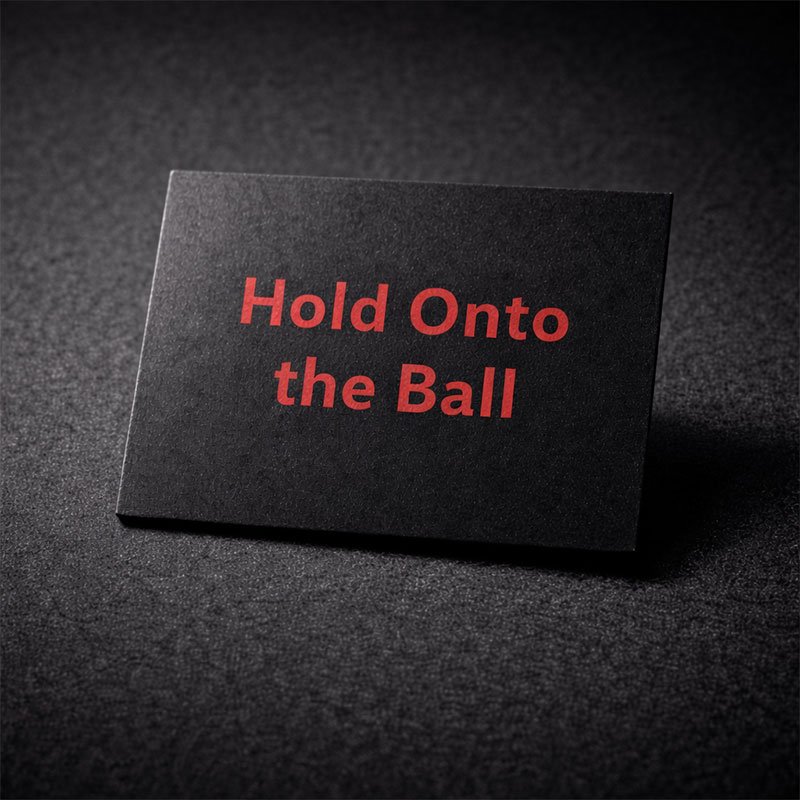
Good coaches tell their running backs, “Hold onto the ball,” not “Don’t fumble.”
It sounds like the same thing. But it isn’t.
A negative cue like “don’t fumble” draws focus to the very act we’re trying to avoid.
“Hold onto the ball” directs focus to the desired action.
When the ball gets knocked loose, the difference shows:
If I was focused on not fumbling, I’ve already failed. Even if I recover the ball, I still fumbled.
But if I was focused on holding onto the ball, the play isn’t over. The goal hasn’t changed. I can still dive on it, get the ball back and hold onto it.
One mindset ends the effort.
The other keeps it alive.
The Avoidance Frame
In psychology, accentuating the negative is known as the avoidance frame.
In their 2013 book, Focus, psychologists Heidi Grant Halvorson and Tory Higgins describe this as a “prevention goal”: keeping bad things from happening.
And this language orients us toward safety and away from risk.
Daniel Kahneman, in Thinking, Fast and Slow, explains why: our brains are wired for loss aversion, reacting more strongly to potential losses than to equivalent gains.
That’s why the language we use doesn’t just shape motivation; it literally changes how our brain operates under stress.
Neuroscience research supports this too. Loss framing activates the amygdala, the brain’s fear center, heightening vigilance and reducing cognitive flexibility.
In simple terms: when we try not to lose, we stop thinking freely.
Prevention talk keeps us cautious, watching for mistakes instead of opportunity.
We become careful instead of creative.
We start playing not to lose.
In most work, where progress depends on initiative and momentum, that defensive mindset quietly kills performance.
If we are playing to win, how we talk about our goals is paramount.
The Winning Frame
As Kahneman points out, our brains naturally move us to protection.
And this tendency shows up in our language.
It’s what my leader said when he warned, “Don’t screw this up.”
He certainly wasn’t trying to de-motivate us or intentionally put negative thoughts into our heads.
And I’ve said it myself.
Seemingly innocuous phrases that begin with “Don’t…”
“Don’t miss the deadline,” or “Don’t screw this up.”
We may be trying to be helpful, but that language doesn’t motivate. It narrows focus to the risk of failure.
If you’ve ever managed a team that hesitated to make decisions or waited for approval, this is often why.
We shift the team from trying to succeed to trying not to mess up.
Good leaders flip the frame.
They describe the behavior they want to see.
“Let’s hit our target.”
“Be ready by Friday.”
“Make this simple and clear.”
Those directions point the mind toward action.
They define success instead of fear.
The Personal Frame
The same principle can show up in how we talk to ourselves.
“Don’t blow it.”
“Don’t say something stupid.”
“Don’t screw up this meeting.”
Those words might sound harmless, but they shape our focus more than we realize.
When we picture failure, we often find it.
Try swapping the frame:
“Stay calm.”
“Be clear.”
“Show what you know.”
You’ll feel the difference instantly. Tension drops, confidence rises, and your brain goes to work on how to win instead of how not to lose.
Because whether it’s a presentation or a playoff, the words we choose before the play matter.
They set our direction…toward winning or away from it.
The Takeaway Frame
Language frames the direction.
It tells the brain what to look for and what to avoid.
When our words center on risk, our teams move to protect.
When they center on possibility, our teams move to perform.
Winning isn’t about ignoring risk; it’s about framing it the right way.
“Hold onto the ball” keeps us in motion.
“Don’t fumble” stops us in our tracks.
So, if you’re playing to win, speak to where you want to go.
Speaking about what to avoid just invites fear in.
Because our words don’t just describe our mindset, they create it.
Teaser: Note that there are times when we can use the avoidance framework for good. Tune in next week.
