


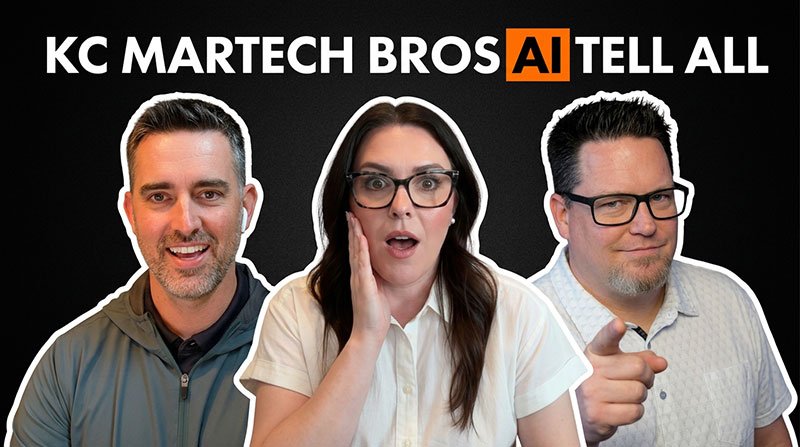
A few weeks ago, Brody Dorland, my co-founder at Forge & Fathom, and I sat down with Heather Gerdes, Co-Founder of ProMode.ai on the Tenfold AI Podcast to talk about what’s actually changing in B2B marketing, and what isn’t.
We covered a lot of ground: the explosion of martech tools, how AI is reshaping content discovery, what marketers still have to do themselves, and why so many companies are quietly panicking about channels that no longer work the way they used to.
But the thread that ran through all of it, which keeps coming up in every conversation we have with operators right now is this:
How you show up in AI exposes the real truth behind your go-to-market strength.
The Mirror No One Asked For
We recently built an AI visibility tool, AI360™, into our diagnostic framework. The tool gives us a quick snapshot of how your company appears (or fails to appear) when buyers use AI systems to research solutions in your category.
As we’ve deployed the tool as part of our client and prospect engagements, we weren’t expecting it to be the most emotionally charged part of those conversations. But it consistently is.
Here’s why: when a company discovers that AI systems are describing them inaccurately — wrong positioning, outdated product descriptions, misaligned messaging pulled from a third-party review site nobody updated in four years — the instinct is to call it an AI problem.
It isn’t. AI is a mirror that reflects the state of your actual go-to-market foundation — how clearly you’ve defined what you do, who you do it for, and why it matters. If the reflection is wrong, the foundation needs work.
That’s not a comfortable finding. But it’s a very useful one. Because it helps us point to exactly what needs to be fixed.
The Rented Land Problem
One of the things Heather mentioned in our conversation that stuck with me: a lot of B2B companies built their pipelines on rented land – distribution channels they controlled tactically but never truly owned structurally. Obvious examples being Google rankings, paid search performance, social networks.
Those channels worked well enough for long enough that the underlying positioning work (the ICP clarity, the differentiation, the messaging that actually resonates with the right buyers) never got the attention it deserved.
Now AI-mediated search is eating into that traffic. Ads are underperforming. Organic reach is falling. And companies are scrambling for the next tactic.
Definition
AI-Mediated Search
An information retrieval model in which AI systems synthesize answers from across the web — rather than returning a list of links for users to evaluate themselves. Instead of clicking through to source pages, buyers receive a composed response. Whether your company appears in that response, and how accurately it’s represented, depends on the signal your content sends across the full information landscape.
The problem with scrambling for tactics on a shaky foundation isn’t that they won’t work. It’s that AI-enabled execution speed means you can move farther in the wrong direction faster than ever before.
You may feel like you’re productive and making progress. You’re moving fast. But you’re actually moving faster than ever in the wrong direction. And falling further and further behind your competition.
Kind of scary isn’t it?
So What Can You Do?
When we run a Fathom360 diagnostic, we’re not auditing tactics. We’re looking at the foundational health of the entire growth engine, including positioning, ICP definition, messaging coherence, channel fit, team alignment, and yes, AI visibility.
What we consistently find is that the symptom a company came in with, like a stalled pipeline, underperforming campaigns, or a sales and marketing team pulling in different directions, traces back to something foundational that’s been unexamined for a long time.
The AI visibility piece often makes that visible faster than anything else. Because when you can show a leadership team exactly how their company is being represented (or misrepresented, or absent) in AI-generated responses, the conversation about foundation stops being abstract.
The mirror makes it concrete.
The Full Conversation
We go deeper on all of this in the episode, including:
- What AI genuinely can’t do (and why that matters more than most people realize)
- How we think about the martech landscape
- What qualities Brody and I think will separate the marketers who win in this environment from the ones who get buried in tool subscriptions and AI-generated noise.
Is the Mirror Showing You Something?
If you’re watching your traffic flatten, your messaging land differently than it used to, or your team spending energy on tactics that aren’t converting, there’s a good chance the foundation is the issue, not the execution.
Two ways to start getting clarity:
Run our GTM QuickCheck. It takes five minutes, covers twelve core areas of your growth engine, and gives you a score with a prioritized list of what to address first.
Book a Clarity Call. If you’d rather walk through what you’re seeing with us directly, we’re easy to get to.
Common Questions
Why does AI describe my company inaccurately — and what does that mean for my business?
When AI systems produce inaccurate descriptions of a company — wrong positioning, outdated messaging, language pulled from third-party sources nobody has updated — it’s rarely an AI problem. It reflects the underlying clarity of the company’s own foundation: how precisely they’ve defined what they do, who they serve, and why they’re differentiated. Poor AI representation is a symptom of foundational GTM work that hasn’t been done or hasn’t been maintained.
How does a weak go-to-market foundation show up in AI search results?
Companies that haven’t clearly defined their ICP, messaging, and differentiation tend to surface inconsistently — or not at all — in AI-generated responses. AI systems pull from the information landscape around a company: website copy, review sites, third-party references, and published content. When that landscape is vague, outdated, or contradictory, AI reflects that inconsistency back. The result is misrepresentation in the channel where an increasing share of B2B buyers are doing early-stage research.
