


Let me start with an unfortunate fact… The B2B buyer journey of 2026 is fundamentally different from the journey we’ve been designing around for the last 10 to 15 years. But most B2B teams haven’t yet adjusted their marketing operating model.
That model was designed for a world where buyers discovered vendors through search, sales conversations, and peer networks. It optimized for those channels. It built accountability and measurement around them.
That world hasn’t disappeared. But a new layer has been added on top of it, and most marketing models weren’t built to account for it.
When a buyer opens ChatGPT or Claude and asks which vendors they should consider for a specific problem, your existing marketing operating model is shaping that answer.
Every piece of digital content your team has published, every directory listing someone set up three years ago, every thought leadership post your CEO has written, every review your customer success team did or didn’t prompt for…all of it feeds the systems that generate that response.
What’s missing from most models is the recognition that this is happening. And the organizational infrastructure to do something intentional about it.
From Channel to Perception Layer
My previous posts in this series (1 through 4) covered the what and the why: AI is a buyer research filter; it synthesizes fragmented signals; there’s a structured way to measure how you’re represented, and when AI gets you wrong, it’s almost always connected to foundational GTM issues.
This post addresses the operational question that follows:
What has to change inside your marketing organization to manage this as a strategic capability, not a one-time project?
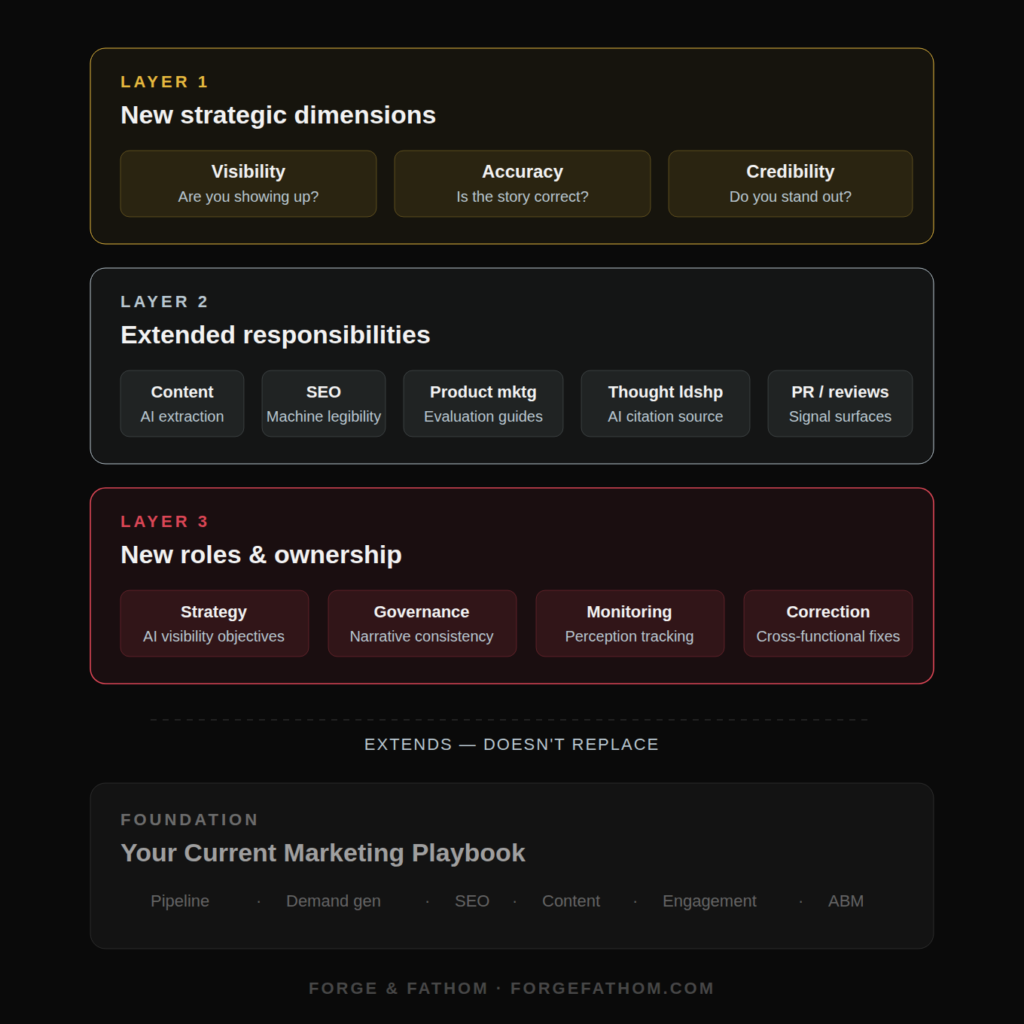
The short answer is three things:
- New strategic dimensions to track and own.
- Extended responsibilities for existing functions that are already shaping AI perception, whether or not anyone has framed it that way.
- And new roles (or role extensions) for the oversight, governance, and monitoring that nobody in most mid-market organizations currently holds.
None of these replace what you’re already doing. They extend it.
Layer 1: New Strategic Dimensions
Marketing teams have gotten pretty good at connecting the dots between channels.
Pipeline connects to demand gen activities. Website traffic traces back to SEO. Engagement follows from valuable content. These are measurable, ownable, and easy to connect to business outcomes.
AI visibility requires the same discipline. The 3 dimensions from Post 3 — visibility, accuracy, and credibility — need to be treated as explicit strategic objectives, not byproducts of existing activity that you hope fall into place.
Visibility: Is your company appearing in AI-generated responses when buyers ask about your category? For which queries, and how consistently?
Accuracy: When AI describes your company, does the response match your current positioning? Or is it synthesizing outdated product copy, stale directory listings, and descriptions that no longer reflect what you actually do?
Credibility: Can AI articulate a clear reason to consider you as a credible, referential source in your space? Or are you a name in a list without a compelling distinction?
These dimensions need owners, KPIs, and regular review cycles. Building them into your planning and reporting infrastructure is the first step toward treating AI visibility as a managed strategic variable rather than ambient background noise.
Layer 2: Extended Responsibilities
There’s an organizational reality most teams are missing: every functional team that creates market-facing content is already shaping AI perception. The content team. The SEO group. Product marketing. Brand and thought leadership. PR. Customer marketing. Sales enablement.
None of them were hired to think about how AI synthesizes what they produce. But that’s what’s happening regardless of whether they think about it.
The practical implication isn’t a full operating model rebuild. It’s a scope extension. Each of these functions needs a new operating dimension added to its existing purpose:
What are the AI visibility implications of the work we’re already doing?
For content, that means asking whether your published material is structured for AI extraction, not just human reading.
For SEO, it means extending machine legibility beyond Google’s crawlers.
For product marketing, it means building comparison content and evaluation guides that AI can use to match buyers to the right vendor.
For brand and thought leadership, it means recognizing that your founders’ LinkedIn presence is now an AI citation source, not just a networking tool.
These are just a few examples of what this change entails, and I’m going to cover this in much more detail in post #6 of this series.
But the main idea I’m trying to establish here is that the extended scope for marketers is additive, not a replacement.
And the key difference is incorporating a new question into the workflow of each team’s output:
Is the thing we’re designing/building/writing/publishing structured in a way that AI can correctly interpret and represent?
Layer 3: New Roles and Ownership
The hardest organizational gap is likely going to be the one that’s almost never filled in mid-market companies: someone needs to own the question “Does AI recommend us for the problems we solve?” on an ongoing basis.
If this AI optimization stuff is treated like a campaign or a quarterly audit, you’re not going to make a dent. This needs to be a dedicated responsibility with a distinct set of activities.
- Strategy: who defines AI visibility and credibility objectives and connects them to GTM goals?
- Governance: who ensures narrative consistency across every surface AI draws from (your website, LinkedIn, review sites, directories, partner pages, media coverage, etc.)?
- Monitoring: who tracks how AI perception evolves over time and flags drift, inaccuracies, or competitive shifts before they start getting ugly?
- Correction: who owns the cross-functional process of detecting misrepresentations and coordinating the fix?
Most mid-market teams don’t have the capacity to fill this with a dedicated internal hire. A senior content person or product marketer often absorbs pieces of it, but they typically don’t have extra time in their day for monitoring, budget for monitoring tools, or the authority to drive corrections when issues bubble up.
This is the organizational gap where external advisory earns its weight. Not as a substitute for internal ownership, but as the infrastructure most teams need to build this capability before they can staff it internally.
Structured oversight, regular AI visibility reviews, and cross-functional coordination aren’t optional once AI becomes a primary buyer research channel. They’re the new baseline.
The First Mover Advantage
You need to move on this. Like, now.
The companies in your category that build this capability first will own the AI-generated short lists in your space.
Since AI systems synthesize signals over time, authority is established through consistent, clear, well-structured presence across multiple surfaces. The math is straightforward. The companies that start building that presence now will be recommended more often, described more accurately, and positioned more distinctly in AI-mediated buyer research. That compounds into pipeline. And it compounds in a channel where, as we covered in post #1, you have no signal when you’re being excluded.
The window to build this without competitive pressure hasn’t closed. But it’s narrowing.
What Has to Change
The marketing operating model that most B2B teams are running isn’t wrong. It was well-designed for the environment it was built for.
But that environment now has a new, multi-faceted layer on top of it. And the model hasn’t been updated to account for it.
Three things need to change: the strategic objectives the model tracks, the scope of responsibility each function holds, and the organizational ownership structure for AI visibility as a dedicated discipline.
None of this is about adding headcount. It’s about extending the existing model intelligently, adding the right oversight roles, and being intentional about a channel that’s already shaping buyer decisions — whether you’re managing it or not.
What’s Next
The strategic frame is clear. What each function actually does differently is the question our next post answers: a function-by-function look at the practical changes that make AI visibility a sustained capability rather than a one-time effort.
Need help building AI visibility into your marketing operating model? Check out our latest offering, AI360™, a complete AI visibility strategy, execution, and monitoring offering for mid-market B2B companies.
