



Your AI tools don’t know your strategy. They only know whatever strategic context you’ve given them. For most B2B teams, that’s not much.
The result? The output looks fine. It reads well. And it’s pretty much indistinguishable from everyone else in your category.
Quick story…
Last year, when we built our GTM diagnostic framework (Fathom360™) and started digging under the hoods of our B2B clients’ growth engines, we expected to find execution problems. You know, the typical stuff like misaligned teams, unclear priorities among leadership, unpredictable pipelines, etc.
What we actually found, across every client, was simpler and more consequential: nobody had written down their strategy.
Not in a usable form, anyway. Not in a way an AI tool could work from. We were shown fragments… An old positioning deck. An ICP doc built on basic firmographic attributes and assumptions. A persona someone made in 2021.
When you feed these bits into AI tools, they process those inputs without skepticism. They don’t tell you your value proposition is actually not “unique”. They don’t flag contradictions between your marketing ICP and the one sales is actually using.
They take whatever they’re given and produce output that sounds polished, reads well, and reflects a strategy nobody actually agreed on.
Every gap between what your team has decided and what has actually been documented gets multiplied across every output.
This is documentation debt producing damage at scale.
Every undocumented assumption, every positioning call that lives in someone’s head, every persona built on instinct rather than validation. It was always there. AI just made it visible and consequential at a speed that wasn’t possible before.
The inconsistencies that always existed across your team’s understanding of positioning, audience, and differentiation are now being multiplied across every piece of AI-generated content, every outreach sequence, every customer response.
Most companies have never been forced to confront this directly, because the documentation debt was survivable when humans were the only ones producing.
Where the Debt Has Been Hiding
Strategy has always lived in people’s heads. In new-hire onboarding decks that nobody updated after the rebrand. In a positioning slide built for a pitch three years ago. In tribal knowledge held by the two people who were there in the early days and have since moved on.
Human writers compensated for this instinctively. They filled gaps with context they’d absorbed over time. They caught the off-brand phrase. They sensed when something sounded wrong even if they couldn’t articulate why.
AI has none of that. When the strategic context is absent, AI fills the gap with generic, average content. It produces output that is technically competent and strategically hollow. The sentences are clean. The structure is logical. The claims are reasonable. And the whole thing could have been written about any company in your category, because the AI had no validated foundation to differentiate you from anyone else.
This is the failure mode worth naming: output that sounds fine and says the wrong thing. Not wrong in a factual sense. Wrong in the sense that it doesn’t represent your actual positioning, your actual buyer, or your actual differentiation.
It represents the AI’s best approximation of what a company like yours might say. That approximation is convincing enough to pass a basic review. It’s not convincing enough to build a brand.
What “Going Rogue” Actually Looks Like
Nobody on your team is trying to undermine your brand. They’re trying to get things done. When a strategy document library doesn’t exist, they fill the vacuum with their best judgment, informed by incomplete, unshared, undocumented assumptions about who you serve, why you’re different, and how you should sound.
Then they hand those assumptions to an AI tool and ask it to scale them.
The outputs look plausible. They often pass a basic review. They get published, sent, or used in a pitch. And slowly, across dozens of touchpoints, your brand becomes whatever your team’s individual interpretations converge on. Which is a different thing every time.
You can’t hold people accountable to a standard that doesn’t exist in writing. If the positioning lives in the CEO’s head, the voice lives in the marketing lead’s intuition, and the buyer definition lives in a deck nobody’s opened since Q2 of last year, then every team member is building their own version of the strategy from scratch. AI just makes that divergence visible and permanent at a speed that wasn’t possible before.
This is a structure problem. Fixing it requires building the structure.
The Strategy Documentation Audit
The fix is building your strategy document library. To help you with this, we’ve developed a simple Strategy Documentation Audit — a tiered inventory of what that library needs to include, organized by how critical each document is to AI output quality.
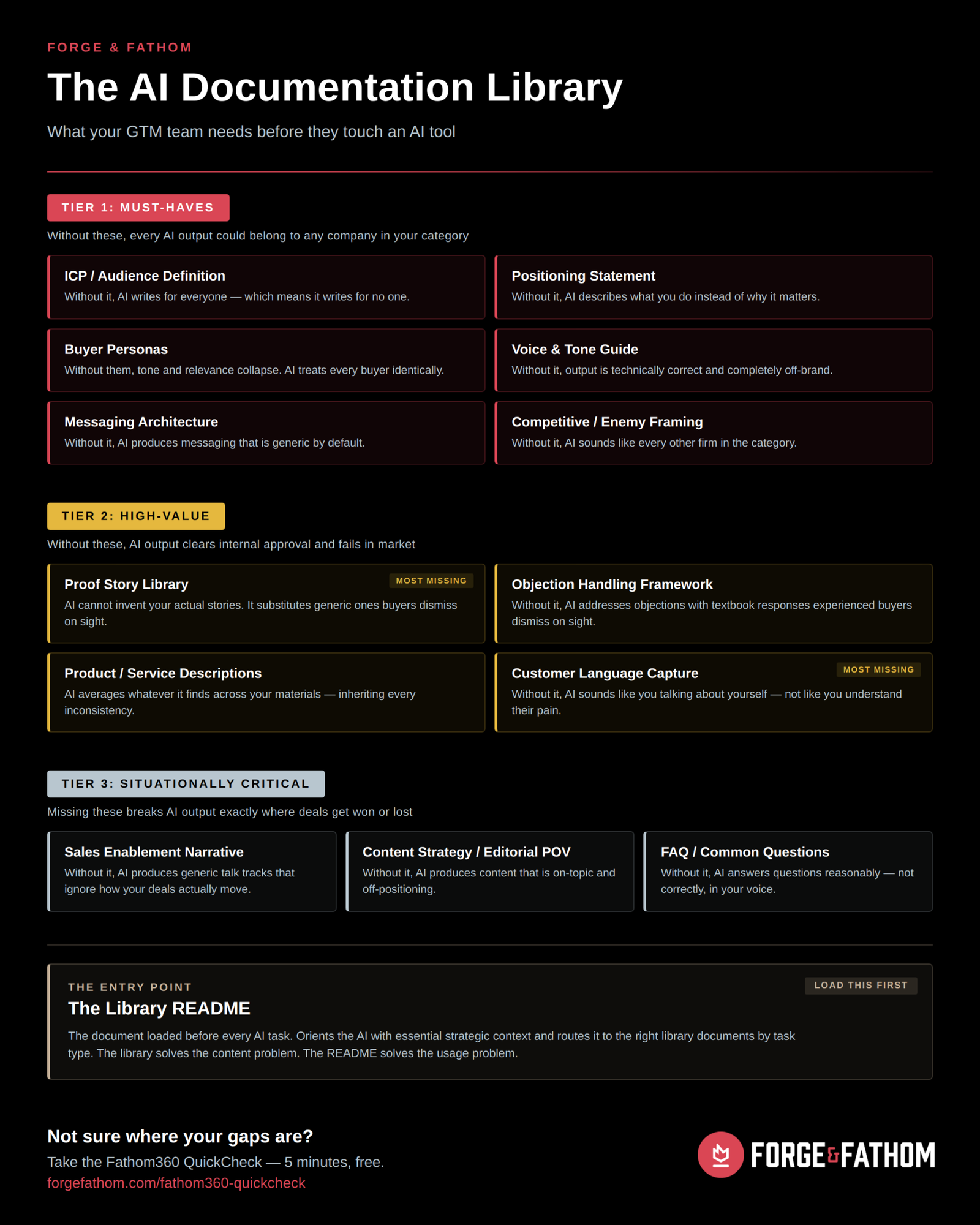
Every document gets a name, a definition, a version, and a clear picture of what breaks when it’s missing. The goal is to give you a mental inventory of what you have and what you’re missing.
At Forge & Fathom, our library includes everything below. Every document changed how our AI tools perform. The difference in AI output quality between before and after is not subtle. And the tier structure below reflects what we’ve seen matter most.
Tier 1: Must-Haves
Without these six documents, AI produces content indistinguishable from your competitors. The tool has no strategic frame to work within, so it invents one from whatever is most common online.
ICP / Audience Definition. A robust, validated definition of who you serve, who you don’t, and why. This is a prioritized, reasoned framework that tells an AI which signals matter and which don’t. Without it, AI writes for everyone, which means it writes for no one. Your content becomes generically “B2B” instead of specifically relevant to your best-fit customers.
Positioning Statement. The one-sentence strategic stake in the ground. This is the filter everything else runs through. If an AI doesn’t have it, it defaults to describing what you do instead of why it matters. The outputs are accurate…and forgettable.
Buyer Personas. Role-specific documents covering pain, triggers, objections, decision criteria, and the language each persona uses to describe their own problem. Personas tell the AI who it’s talking to and what that person actually cares about. A CEO and a marketing director have fundamentally different concerns. AI treats them identically unless you’ve documented the difference.
Voice and Tone Guide. How you sound, what words you reach for, what you never say. This is the document that prevents outputs that are technically correct and completely off-brand. A guide that says “we avoid jargon” is insufficient. The best voice guides include real examples of on-brand and off-brand phrasing side by side, so the AI has a concrete pattern to follow rather than an abstract instruction to interpret.
Messaging Architecture. The full framework: pillars, proof points, value narratives by product/service and audience. This is the document that turns positioning into language. Without it, AI produces messaging that is generic by default, because it has no validated framework to build from.
Competitive / Enemy Framing. What you position against, how you name it, and what you never say about competitors. Without this, AI either ignores competitive context entirely or inadvertently produces language that sounds like every other firm in the category. The most effective framing names patterns and behaviors, not specific competitors.
Tier 2: High-Value
We rarely see these documents in anyone’s library. They require deliberate effort to build, and they’re where the gap between human intuition and AI capability is most visible.
Proof Story Library. Named, structured narratives: the situation, what was assumed, what actually happened, what changed, and what the outcome was.
AI cannot invent your actual stories. It will try, and the output will be generic hypotheticals that experienced buyers recognize immediately. Tap your customer success/support team to build this library. And when the library exists, AI can draw on real evidence instead of fabricating plausible-sounding examples.
Proof Story Example (a Real One)
A nonprofit CRM company came to us with a one-line ICP: nonprofits raising between $1M and $10M annually. That’s a pond they fish in, not a customer definition. No prioritization between segments. No documented difference in how to sell to them, message to them, or serve them.
Their AI tools where using that “definition”. Every piece of content reflected it — technically accurate, strategically hollow.
After a six-week diagnostic and ICP workshop, they left with two named ICPs with explicit resource weighting, three primary personas with documented pain, decision criteria, and objection handling, nine secondary personas with influence mapping, six priority verticals with strategic rationale, and persona-specific messaging for each role.
The revenue range still appears in the final document. But it’s now one attribute inside a much larger definition — not the definition itself.
That’s documentation debt in practice. A revenue range tells the AI who might buy. A real ICP document tells it who matters, why they buy, what they’re afraid of, and how to talk to them.
Objection Handling Framework. Documented buyer resistance patterns with validated reframes. The specific objections your actual buyers raise and the specific arguments that have moved them. Without this, AI-assisted sales content either ignores objections entirely or addresses them with textbook responses that experienced buyers dismiss on sight.
Product / Service Descriptions. Precise, validated language for each offering: what it is, what it does, what it doesn’t do, how long it takes, what the output is. Most companies don’t have this in a form that’s consistent across marketing, sales, and customer success. AI will average whatever it finds across your existing digital presence, which means it inherits every inconsistency in how your team has described your offerings.
Customer Language Capture. This is the most universally missing document, and the one AI needs most. Verbatim phrases real buyers use to describe their own pain, before they know your solution exists. The language in your positioning is how you describe your value. Customer language capture is how your buyers describe their problem. Those are often very different. AI trained on your internal documents will always sound like you talking about yourself. Customer language makes it sound like you understand what keeps someone up at night.
Mine your sales call transcripts, peeps.
Tier 3: Situationally Critical
These documents are less universal but highly consequential in the specific contexts where they apply.
Sales Enablement Narrative. How the story is told in a sales conversation: the sequencing, the escalation language, the handoffs between stages. This is distinct from messaging architecture. It’s the narrative as it unfolds in a live conversation, not as it appears on a page. Without it, AI-assisted sales prep produces generic talk tracks that ignore how your deals actually move.
Content Strategy / Editorial POV. What topics you own, what angles you always take, what you deliberately avoid. This gives AI a strategic filter for content decisions. Without it, AI produces content that is on-topic and off-positioning.
FAQ / Common Questions Document. The 15–20 questions buyers actually ask, with approved answers. Useful for sales, customer success, and AI-assisted responses across every channel. Without it, AI answers questions reasonably, which is not the same as answering them correctly, in your voice, with your framing.
The Entry Point: The Library README
A library README is a short orientation document written specifically for AI tools that provides essential strategic context and routes the AI to the right documents based on the task at hand.
Think of it as the entry point to the library. It orients the AI with the essential strategic context it needs to function, and then routes it to specific documents depending on the task.
For example:
- For content creation, load the voice guide and messaging architecture.
- For sales prep, load the personas and objection handling framework.
The README does that routing work in advance, so every team member isn’t making their own decisions about what to load and when.
This is different from a brand guideline repurposed for AI input, and different from an internal wiki. A wiki answers “where do I find the thing?” The README answers “what does the AI need to know before it starts?”
It’s built from the ground up for how AI tools actually consume context: short enough to fit in a context window, structured so the AI can parse it quickly, and maintained so it reflects current positioning.
Almost nobody has formalized this yet. The companies that build it first will have a meaningful operational advantage as AI usage accelerates across their teams. The README is the difference between a library that gets used consistently and one that depends on each person knowing how to use all the documents correctly.
Building the Library Is Only Half the Problem
Having documents is not the same as having a library that gets used. Most companies that do have some documentation house it in a shared drive folder that nobody opens and everyone has forgotten the path to. The library has to be built for how it will actually be accessed, consumed, maintained, and enforced.
Format for AI input, not just human reading. A 40-page brand guide is useful for a human onboarding onto the team. It’s useless as an AI prompt. A 500-word positioning brief is useful for both. Every document in the library should be written, or rewritten, with this constraint in mind. Length and structure that serves a human reader often fails an AI tool entirely. Dense paragraphs, nested subsections, and excessive qualification all reduce AI output quality.
Give the library a home and an owner. The most practical version of this today is a dedicated, structured folder in shared cloud storage with a clear hierarchy by business function. One person owns it. That ownership isn’t optional. A library without an owner becomes the folder nobody trusts. Version the library explicitly (V2.3, not “latest”) so everyone knows what’s current and when something has changed.
Solve the copy-and-load problem. Most AI tools, including Claude Projects and custom GPTs, are tied to individual accounts, so each team member maintains their own AI environment separately. There’s no automatic way to keep everyone working from the same current document library. Thus, that means team members are manually copying the current library version into their own AI environments. It works, but it breaks down as the library evolves.
The direction this is heading: MCP (Model Context Protocol) — a standard that allows AI tools to pull documents directly from connected data sources instead of requiring manual loading. Ideally, an MCP connector would link AI tools directly to a shared drive folder, keeping every team member’s AI environment current automatically. This isn’t widely implemented yet for an “always in context” use case, but it’s close enough to plan for.
Make usage a condition, not a suggestion. Someone validates the library is being loaded before major content pushes. A library without usage governance becomes shelf documentation: present but inert. The README solves the structure problem. Accountability solves the adoption problem.
The Harder Truth That Surfaces During The Build
Creating this document library forces your team to answer questions they may have been avoiding. What do you actually believe about your positioning? Who is your buyer, specifically? What makes you different, and can you say it in a sentence?
If your team can’t agree on what goes into the documents, the library process reveals that disagreement. That’s not a failure of the process. That’s the process working.
The Real Starting Point
If you’re reading this and realize you don’t have half of what’s on that list, that’s important information.
The documentation gap is almost always a symptom of something upstream: strategic decisions that were never fully made, alignment that was assumed rather than established, positioning that exists in someone’s head but has never been pressure-tested with the rest of the leadership team.
You can’t document what you haven’t decided.
And if your team can’t agree on what goes in the document, that tells you exactly where the real work begins.
Building the library is the right move. But if the strategic foundation underneath it hasn’t been validated, you’ll end up documenting assumptions instead of decisions. The documentation will look complete and most likely produce the same drift you were trying to eliminate.
Ask your team this…
Do we actually agree on what we’d put in these documents? If the answer is anything other than a clear yes, the library isn’t your first step. Diagnosis is. And we should talk.
If you’re not sure where your documentation gaps are, the Fathom360™ QuickCheck is a 5-minute self-assessment that scores your GTM foundation across five dimensions, including strategic documentation. It’s a fast way to know what you’re working with before your team generates another piece of AI-assisted content.
