


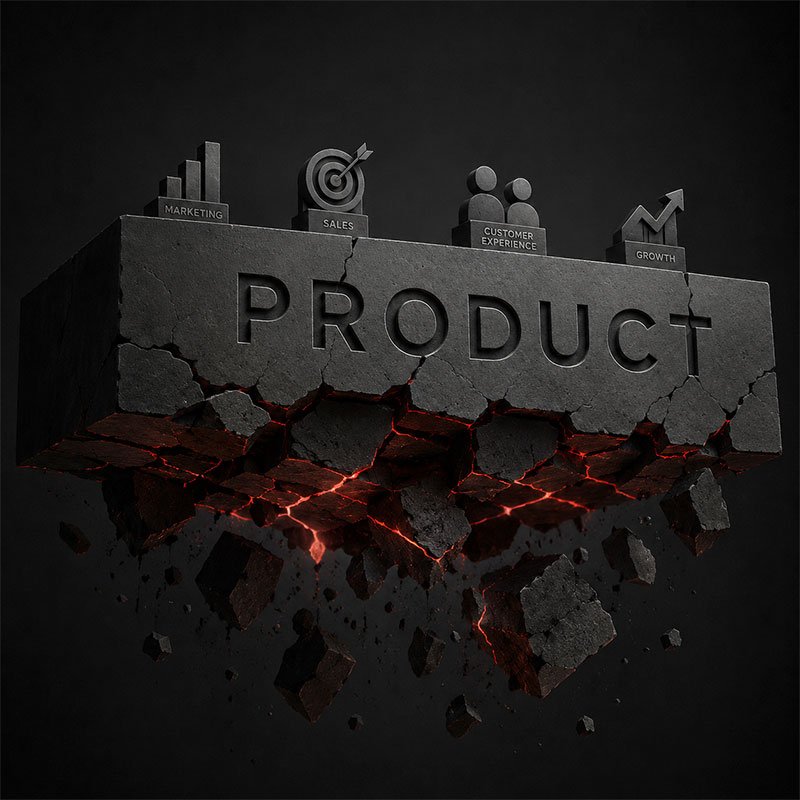
When we’re kicking off a growth diagnostic or growth strategy engagement at Forge & Fathom, there’s an inevitable logistics question that gets asked:
“Who should we invite to these conversations?”
I wrote about this last week. I’ve found myself pausing to let the client take the first pass at the answer. The list of people most leadership teams build when asked that question tells you exactly which functions they think of as growth drivers, and which ones they think of as something else.
Last week I talked about how post-sale leaders (ex: a Head of Customer Experience) almost never make the first cut.
But even the teams that catch themselves and expand the list still tend to leave one seat empty: the product leader.
The Most Expensive Question Nobody’s Asking
Before we get into what product brings to a strategy conversation, there’s a more fundamental issue worth naming.
What if the core problem holding back your growth is the product itself?
Set aside your messaging, demand gen activities, and sales motion for a minute. What if your product or service is delivering less value than it once did, losing ground to alternatives, or quietly falling short of what customers actually need?
This happens more often than leadership wants to acknowledge. Today, markets are evolving quickly. Competitors are constantly sharpening their offerings, and customer expectations can shift in months, not quarters.
Reforge, whose product strategy research reaches tens of thousands of product and growth leaders, calls this “Product Market Fit Collapse” — the moment customer expectations move fast enough that a product stops earning its keep before leadership has registered the threat.
A product that earned strong retention two years ago can start losing its grip without anything obvious breaking.
There may be subtle signs as targets get harder to hit. The win rate gets less consistent. Expansion conversations get more difficult. Per usual, leadership is going to look at the typical GTM functions for answers.
And the one function with direct visibility into whether the product is still earning its keep isn’t in the room.
That’s the highest-stakes version of why product’s absence is so costly. You can run a well-executed growth strategy on top of a product that’s quietly losing its relevance and not find out until the numbers make it undeniable. By then, two or three quarters of investment have gone into optimizing the wrong thing.
Marketing and sales rarely hear these signals. Only product can tell you whether the foundation is still sound, and only if someone thought to invite them.
Why Product Gets Left Out Anyway
Product leaders carry a specific mental label in most companies. They build things. They execute on strategy. They ship what everyone else decides to prioritize.
That mindset has a lot of practical truth to it. But it leaves the function with the deepest structural knowledge of what your company actually delivers — who it genuinely serves well, where value holds up, where it doesn’t — sitting outside the conversation about where to take the company next.
Product is where all of the company’s delivery assumptions get stress-tested in real time. Every customer interaction is a live experiment about whether your ICP is right, your differentiation holds past the sale, and your roadmap is pointed at problems that actually exist.
Most growth strategy conversations never access this critical evidence.
What a Strong Product Leader Actually Brings
When a strong product leader is in the room, three things become possible that aren’t possible otherwise.
Why You Need a Strong Product Leader at the Growth Strategy Table
A Feasibility Check
When leadership decides to pursue a new market, there are two questions on the table: Is the opportunity real? And can we actually deliver against it? Marketing and sales can answer the first. Only product can answer the second.
A Market-fit Check
Feasibility tells you whether something is buildable. Market fit tells you whether what you’ve already built actually solves the right problem for a new buyer. A strong product leader can tell you not just “yes, that feature exists” but whether a customer in that market would actually get value from it.
Sequencing Judgment
What has to be true before you can credibly serve a new market? What gets built first, deferred, or scoped out entirely? Leadership often commits to a direction before anyone has worked through that sequence. Product is the function that forces it.
The Ground Truth Problem
CX holds a valuable evidence stream. I made that case last week. But CX evidence is experiential. It lives in conversations, support tickets, renewal calls, churn moments.
Product holds something different. Call it ground truth.
Product has empirical data that shows which customer types actually get value from what you’ve built versus which ones you’re technically serving but quietly struggling with.
They know where the product experience gets wonky when you push it toward a use case it wasn’t designed for.
They know which features exist because customers asked for them and which ones exist because leadership had a thesis the market politely ignored.
I saw this firsthand at a previous company. We kept getting requests for a specific integration from prospects, from existing customers, and from sales. So we built it and launched it with a full campaign. Deals closed. The integration became part of the pitch.
What we didn’t have in the room when any of those decisions got made was someone with honest visibility into whether the integration actually worked the way customers expected it to. It didn’t. And we kept selling it anyway.
The churn showed up months later, distributed across accounts in a way that took a while to connect back to the original problem. By then the damage was already priced in.
The Specific Break Pattern I See Most Often
Marketing and sales are diagnosing a demand problem. Something is off…conversion, pipeline velocity, deal size. They’re looking at funnel metrics trying to find the weak spots.
CX is surfacing signals from the post-sale experience: customers struggling in certain segments, expansion conversations stalling in similar ways, a churn pattern that looks random until you look closer.
Product is the only function that can connect what CX is surfacing post-sale to the structural question underneath. Is this a messaging problem? A fit problem? A product problem? Are you selling to the right buyer but describing the product wrong, or selling to a buyer the product genuinely doesn’t serve yet?
Without product in the room, that question never gets asked cleanly. Leadership picks a diagnosis that fits the data they have and spends the next two quarters optimizing against the wrong issue.
The Honest Reason Product Gets Excluded
I want to be straight about this, because “product should have a seat at the table” undersells the real dynamic.
Product leaders can genuinely slow a strategy conversation down.
They ask hard questions about feasibility. They push back on market assumptions with internal data that complicates an idea everyone was getting excited about. They have a bias toward what’s been built and what they know works, which can read as resistance when leadership is trying to build momentum around what’s next.
I’ve been in strategy conversations where the product leader’s presence changed the energy in the room in ways that felt, in the moment, like a headwind.
But that friction is structural pressure-testing. Every place a product leader pushes back is a place where a go-to-market assumption is either load-bearing and worth defending, or shaky and worth knowing about now rather than six months into execution.
Strategy sessions that never encounter that friction produce confident plans built on unchallenged assumptions. These tend to turn into expensive problems down the road.
One More Reality (For Many Companies)
Plenty of companies don’t have a product leader who can walk into a strategy conversation and speak with authority about feasibility, fit, and sequencing. Startups and mid-market companies often have a personnel gap here. Reliance on a founder or a lead engineer can be a sign that the company lacks objective visibility into what it’s actually built and who it genuinely serves.
Growth strategy made without that clarity runs on assumptions the company has never actually tested.
What Changes When Both Seats Are Filled
Last week I made the case for what CX brings: a continuous evidence stream about whether your GTM assumptions are holding up after the sale.
Product is where that evidence has to land to mean anything strategically. A recurring support issue is noise until someone with product knowledge can say whether it reflects a real fit problem or a solvable configuration issue.
Your churn rate is a data point until product can tell you whether it’s exposing a genuine gap in what you’ve built or something is off upstream.
When CX and product are both in the room, growth strategy stops being a bet on what the market might want and becomes a grounded conversation about what you’ve actually learned and can credibly execute against.
That’s the difference between a strategy session and a growth diagnostic. One starts from where you want to go. The other starts from what’s actually true.
Before Your Next Growth Planning Conversation…
Ask this: Who can tell you whether the product is still earning its keep, and what it would take to serve the next market you’re considering?
If the answer is nobody, you’re making growth decisions without the function that holds the delivery reality your strategy depends on. The next investment you make will be shaped by what leadership believes is true rather than what the company has actually learned.
Common Questions
Why should product leaders be included in growth strategy conversations?
Product leaders hold the delivery reality that every other growth function depends on. They can tell you whether a new market is actually buildable against what you’ve shipped, whether the product still creates the value it once did, and whether the diagnosis your marketing and sales teams have landed on is a GTM problem or a product problem. Without them, growth strategy runs on assumptions nobody has tested against what the company has actually built.
What are the signs that a product problem is being misdiagnosed as a GTM problem?
The pattern usually looks like this: win rates soften, expansion conversations stall, and churn starts appearing in segments that used to perform. Marketing and sales keep adjusting the GTM motion — messaging, targeting, offers — without improvement. The root cause is that nobody has asked product whether the product itself is still fit for the buyer being pursued.
