


Picture a buyer…a VP of Operations at a $30M professional services firm.
They’ve got a problem. A real one. The kind that’s been quietly eating margin for months. They open ChatGPT and start typing. No category terms. No company names. Just the problem, in their own words, the way they’d describe it to a peer over coffee.
What happens next determines whether you’re in the conversation or not.
Most B2B companies that are trying to crack the code on AI search visibility right now are building toward the wrong version of that moment.
They’re tracking visibility scores based on citation counts (i.e. brand mentions in AI responses). Don’t get me wrong…those metrics tell you something. They tell you whether AI systems have catalogued your existence.
What they don’t tell you is whether you show up when it matters most: when a real buyer, using real language, describes a real problem and asks for help.
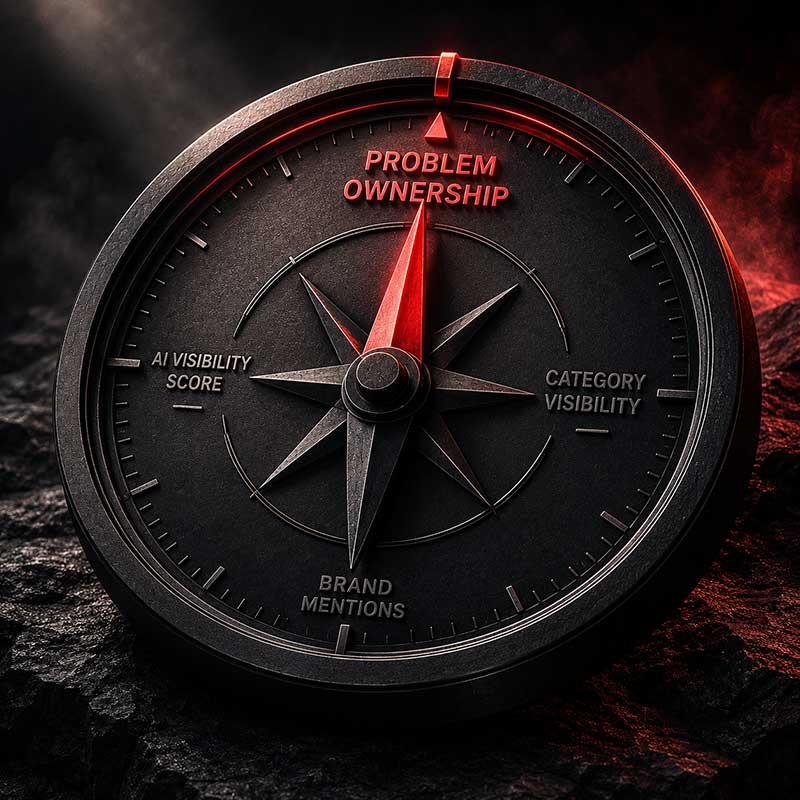
That’s a different outcome entirely. We call it Problem Ownership.
Definition
Problem Ownership
The state in which AI systems associate your company with a specific buyer problem — recommending your company when a prospect describes that problem in natural language without naming categories, competitors, or the company itself. Companies that own a problem show up consistently, accurately, and ahead of alternatives across AI engines.
Most AEO (Answer Engine Optimization) programs are optimizing for category-level visibility (“best tools for X”) or branded queries (“how does Company Y compare”).
Problem Ownership is something narrower and more valuable: showing up when a buyer describes their specific situation, not when they search a category.
The query that opens a sales conversation sounds like: “We keep losing deals in the final stage and I can’t figure out why.” Or: “Our team is generating a lot of content but nothing seems to be generating leads.” Or: “I feel like we’re spending in the wrong places but I can’t prove it.”
When a buyer types something like that, which companies appear?
Case In Point
In our AI360 engagements, we run the same company through both types of queries routinely.
A recent analysis for a packaging automation company found that they had some visibility for category-level queries like: “What automated packaging equipment helps eCommerce retailers reduce package size and lower shipping costs?”
But upstream of that was the problem-level query: “We’re struggling with shipping costs. What are some ways to reduce materials waste and optimize package sizes for my eCommerce company?”
Our client was invisible at the problem stage.
This pattern is consistent: decent scores on category-level queries, then near-invisibility the moment the query shifts to problem language.
That company exists in AI training data. It surfaces when the question is aided by a specific type of product or service. But it disappears when the question is real.
Why Most B2B AEO Programs Miss This
Most AEO engagements are being run by SEO practitioners right now. Their default starting point is the same one it’s always been: a target keyword list. Those keywords get converted into questions, answers are crafted, and that content is getting distributed across every channel that makes sense.
It’s a logical sequence, but it starts in the wrong place.
Keyword lists are built from category terms and product searches: queries from buyers who already know what they’re looking for. Problem Ownership requires showing up before that moment.
It makes sense, given where SEOs are coming from. SEO thinking is keyword-level thinking by design. The jump to problem-level queries requires a different frame, one that starts with buyer psychology and strategic positioning, not search behavior.
Most practitioners haven’t made that jump yet. So they default to what they know, and optimize for what’s easier to measure.
Measuring AI visibility consistently is hard. AI responses are probabilistic by nature. You can run the same query hundreds of times and never get the same set of vendors twice.
Back in January 2026, Chris Penn of Trust Insights did an experiment where he ran the same query in Claude and it took 1,429 iterations to return the same two brands in the same order.
That imprecision doesn’t make measurement useless. You don’t need a precise number to know whether you’re showing up or not.
But common technical optimizations like improving schema markup, structured data, FAQ content, and backlink structure are much easier to measure, and they’re all legitimate AI signals.
So SEO shops are going to lead with those and slap an AEO/GEO service label on it.
A Real B2B AEO Strategy Starts Here
The question most companies never ask: Which problems are worth trying to own in the first place?
Most skip this and go straight to execution without doing any of the work that would make this answerable.
Your buyers have lots of problems, many of which aren’t relevant to what you sell. And of the buyer problems that are relevant, not all of them are winnable.
Before you brainstorm which problems you might want to own, you need to know where you actually win commercially, as in the products and services with the strongest margins, the shortest sales cycles, the deepest proof points.
Problem selection that isn’t anchored around your best products and services is aspirational at best.
With that established, you inventory what ownable IP you have against those commercial anchors. Do you have named frameworks, proprietary processes, or coined terminology that connects directly to your highest-value offerings?
The answer determines your execution strategy more than any channel decision will.
The Winnable Problem Filter
You’re essentially creating a filter to aid in your problem brainstorming and selection process. And for most mid-market B2B companies, that filter serves a second purpose: prioritization.
You likely don’t have the budget or bandwidth to pursue every problem worth owning. The goal is to find the 3 to 5 where focused effort produces durable visibility and qualified opportunities, not a long list that spreads resources thin.
Before you make any execution decisions, consider these three criteria, in order:
- Strategic alignment – Does the problem map to your ICP, your positioning, and the stage of the buyer’s journey you’re trying to reach? A buyer experiencing a problem for the first time articulates it very differently than one who has already named it and is evaluating solutions. Owning the early, unstructured version of a problem (before buyers have category language) is where Problem Ownership has the highest strategic value. If your content only answers late-stage queries, you’re invisible at the earlier moment that matters most.
- AI winnability – Is the problem area too crowded for a company at your scale to realistically compete on? Or too niche for meaningful training data coverage? The goal is the intersection: specific enough to own, broad enough to matter.
- Profitability – If we became the go-to answer for this, does it drive qualified opportunities and revenue? Owning a problem that doesn’t convert to meaningful revenue is a vanity play.
Most AEO engagements start at execution. Schema markup first, problem strategy never. When companies do the work in this order, they could end up with optimized infrastructure pointing at the wrong questions.
What Makes Problem Ownership Achievable
There’s a reason some companies build Problem Ownership faster than others, and it’s not content volume.
Companies with named, published Ownable IP surface in problem-level queries faster than companies competing on signal volume alone, because AI systems have something to attribute.
This very blog post itself is an example. “Problem Ownership” is a named methodology that we, the founders of Forge & Fathom, created. We’ve built a proprietary service offering around it called AI360™. And our goal is to own the following problem:
“How do I get my B2B company recommended when buyers are researching in AI tools?”
By publishing this blog post, we’re putting this named strategic framework out into the digital world and AI systems will attribute it to Forge & Fathom. Generic advice on this same topic will be much less likely to get cited.
So let’s think about your ownable IP… Which of these three situations are you in?
IP exists and is already named and published. This is the strongest position. The IP becomes the primary vehicle for owning the associated buyer problem. Channel and content work builds around it.
IP exists but hasn’t been named or published. Naming and publishing it is the highest-priority move — faster, more durable, and more defensible than any volume-based approach. Execution follows that, not the reverse.
IP doesn’t exist. You’re competing on signal volume alone, which is slower and more expensive. That’s not disqualifying, but it’s an honest starting point. In some cases it also means the problem you’re trying to own isn’t one you have the authority to own yet.
Definition
Ownable IP
Any proprietary, nameable concept a company can credibly claim authorship of that connects directly to a buyer problem they want to own. Includes named methodologies, proprietary processes, products, service offerings, and coined terminology. The presence of Ownable IP is the single fastest accelerant for Problem Ownership.
Most AEO engagements don’t call attention to these assets because they go straight to channel analysis. The IP inventory is what separates a strategic AEO engagement from a tactical one.
Considering what we’ve learned about how LLMs handle attribution in retrieval tasks, AI systems extract from what’s attributable.
When a company has a named framework, a coined concept, a methodology that appears across multiple platforms with a consistent label, that’s something an LLM can grab onto, attach to a source, and reproduce with confidence.
Generic content, even high-quality generic content, competes on volume. Ownable IP competes on attribution.
This doesn’t mean every company needs to coin a term tomorrow. But the companies that move fastest on Problem Ownership tend to have at least one anchor: something named, something specific, something that other sources have referenced back to them.
Without it, you’re asking AI systems to synthesize your identity from a pile of unlabeled signals. Some do it reasonably well. Most produce something generic enough to be useless.
Ownable IP probably deserves its own post. For now, the practical implication is this: if you want to own a problem in the AI landscape, give AI something to attribute.
Decision Time
The B2B companies running strong AEO programs have one thing in common. They started with a strategic decision, not a tactical one. They identified which specific problems they wanted to own before they wrote a word of structured content or built a piece of schema markup.
That decision requires knowing your ICP and buyer personas inside and out. It requires honesty about where you can actually compete in the AI landscape versus where you’re just hoping to show up. It requires connecting problem ownership to revenue, not just visibility.
Most companies haven’t had that conversation. Heck, many companies are just starting to have conversations about their current AI visibility score. Both are important conversations, but the strategic conversation needs to happen first.
If you want to know where you actually stand — not just your score, but which problems you own and which you’re invisible for — an AI360™ Snapshot Report is where that conversation starts. And we’d be happy to run one for you (FREE).
We’ll help you identify the problems you should target, and provide a roadmap to ownership and revenue. Schedule an AI360 discovery session today.
Common Questions
What is Problem Ownership in AEO strategy?
Problem Ownership is the state where a company is consistently recommended by AI systems when a buyer describes their specific problem in natural language — without naming categories, competitors, or the company itself. It differs from standard AI visibility because it measures whether a company surfaces on problem-level queries, not category or keyword-centered searches. Most companies score reasonably on category queries and go nearly invisible when the query shifts to real buyer language.
How does B2B AEO differ from general AEO practice?
B2B AEO differs from general AEO practice primarily because of how B2B buying decisions are made. B2B purchases involve longer evaluation cycles, multiple stakeholders, and problems that often don’t have a recognized category or solution name yet. That means B2B buyers frequently enter AI systems with unstructured, situational language — describing a business problem, not searching a product category. General AEO advice tends to optimize for queries where buyers already know what they’re looking for. B2B AEO strategy has to reach buyers earlier in that process, before the problem is named, which requires anchoring content in buyer psychology rather than keyword infrastructure.
Why do most AEO programs start with the wrong queries?
Most AEO programs are run by SEO practitioners whose default starting point is a target keyword list. Keyword lists are built from category terms and product searches — queries from buyers who already know what they’re looking for. The jump to problem-level queries requires a different frame, one that starts with buyer psychology rather than search behavior. Because problem-level queries are harder to measure and don’t map to existing keyword infrastructure, practitioners default to what’s measurable: schema markup, structured data, and FAQ content. The result is optimized infrastructure pointing at the wrong questions.
How do I choose which problems to try to own in AI search?
Problem selection should start with commercial alignment — identifying which offerings have the strongest margins, shortest sales cycles, and deepest proof points. From that commercial ground, filter candidate problems through three criteria in order: strategic alignment with your ICP, AI winnability given your scale and the problem’s specificity, and revenue potential if you own it. Most AEO engagements skip this step entirely and optimize infrastructure pointing at the wrong questions.
