



LinkedIn’s AI Strategy Lead, Purna Virji, made an observation recently that’s worth building on…
The B2B buying committee is no longer entirely human.
AI is now a participant in how buyers evaluate vendors, not just how they discover them. Since everyone has their own AI assistant now:
- Procurement is going to use it to justify a choice to Legal.
- A champion is going to use it to defend a shortlist to Finance.
- Buying committees are going to use it to stress-test a vendor’s claims before anyone has talked to sales.
These are different use cases than your company showing up in an AI-generated answer. And for mid-market B2B companies focused on trying to build AI visibility, it’s a problem most haven’t grappled with yet.
Here’s the question I’m posing to you… Will AI make a credible case for you when a buyer starts asking harder questions?
That’s where proof comes in.
Claiming a Problem vs. Owning It
Last week I introduced the concept we call Problem Ownership. (NOTE: I’d highly recommend you read that article first, if you haven’t yet)
Definition
Problem Ownership
The state in which a company is consistently recommended by AI systems when a buyer describes their specific problem in natural language — without naming categories, competitors, or the company itself. It’s the north star of any AEO strategy.
But there’s a gap between claiming a problem and actually owning it.
“Claiming” is what happens when a company publishes content about a problem they solve. “Ownership” is what happens when AI systems have enough corroborating evidence, from enough independent sources, to reproduce your name with confidence across query variations, platforms, and time.
The distance between those two states is proof. AI needs receipts.
How AI Builds Confidence
AI answer engines don’t work like a database. They don’t retrieve a single authoritative source and return it. They synthesize. They build a probabilistic response from the aggregate weight of corroborating signals across everything they’ve been trained on or can retrieve.
That distinction matters more than most companies realize.
When a buyer describes a problem in ChatGPT or Perplexity, the model isn’t checking whether your company has claimed authority over that problem. It’s assessing the weight of evidence: how many sources, from how many independent directions, point to this company as a credible answer for this specific situation.
Repetition from a single source produces diminishing returns. Corroboration across multiple independent sources is what actually shifts the output.
This is why Problem Ownership is harder to manufacture than traditional SEO. You can’t optimize your way to it with a single well-structured piece of content. The model is looking for weight of evidence, and that evidence has to come from two distinct directions.
The Two Evidence Layers
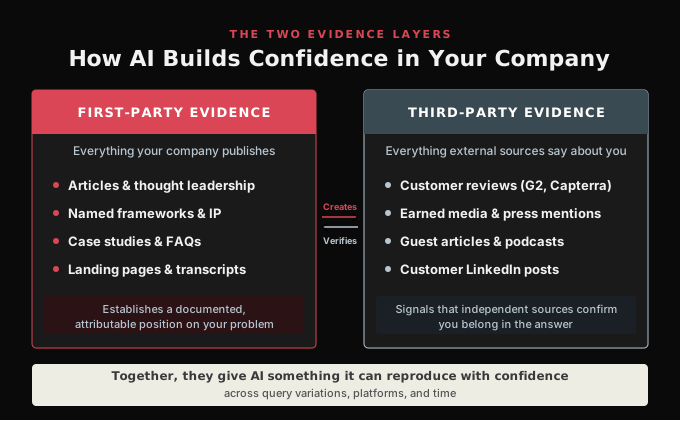
First-party evidence is everything your company publishes and controls: blog posts, case studies, named frameworks, FAQ content, landing pages, video transcripts, and podcast appearances where content is indexed. This is the layer most companies default to, and where most content strategies live.
First-party evidence establishes that your company has a credible, documented position on a problem. It gives AI systems something attributable: a consistent narrative about your solution, from a clear source, across multiple touchpoints.
Third-party evidence is everything external sources say about you: customer reviews, press mentions, guest articles, podcast appearances on third-party shows, LinkedIn posts from customers, references from credible industry sources. This is the layer most mid-market companies underinvest in because, well, it can be expensive, and it’s harder to control.
But third-party evidence is all-but required as it does something first-party evidence cannot. It signals to the model that sources with no promotional stake in your company corroborate the claim that you belong in this answer.
A company with fifty blog posts on a buyer problem has a documented position. A company with fifty blog posts AND third-party sources citing it in the context of that same problem has evidence that crosses source boundaries. The model treats those very differently.
Why One Layer Isn’t Enough
First-party evidence alone is a claim. It’s your company asserting its own authority. That has real weight, but it’s limited by the fact that every source pointing to you is controlled by you.
Third-party evidence alone is noise without a home. If external sources mention your company in a certain context but there’s no coherent, attributable body of first-party content for the model to anchor to, the references don’t benefit you. The AI has no clear framework to return.
For example, if you claim your company makes the best tires in the world, but reviews for your company talk about your amazing ice cream, the AI is going to throw its imaginary hands in the air in confusion. It’s going to recommend the vendor whose proof matches the pitch.
The two layers are structurally dependent on each other. First-party content grounds the solution. Third-party signals verify it. Together, they give the model something it can reproduce with confidence across query variations and platforms.
This is also what Virji is pointing at when she describes the gap between what a company claims and what AI can actually verify on behalf of a buyer.
For mid-market B2B companies, AI may find that the outcomes in your case studies are too vague to be useful. The proof points in your content don’t survive a follow-up question. Or the only people saying good things about you are you.
AI is very good at noticing that.
Our Data Shows a Clear Correlation
Across 100+ AI360™ analyses (thousands of queries) we’ve run for clients and prospects, a pattern shows up consistently. When we query LLMs directly to identify the sources shaping their training data for a client’s industry, we categorize what we find: analyst citations, editorial comparisons, industry publications, practitioner communities, third-party and partner sites, government sources, and other relevant signals.
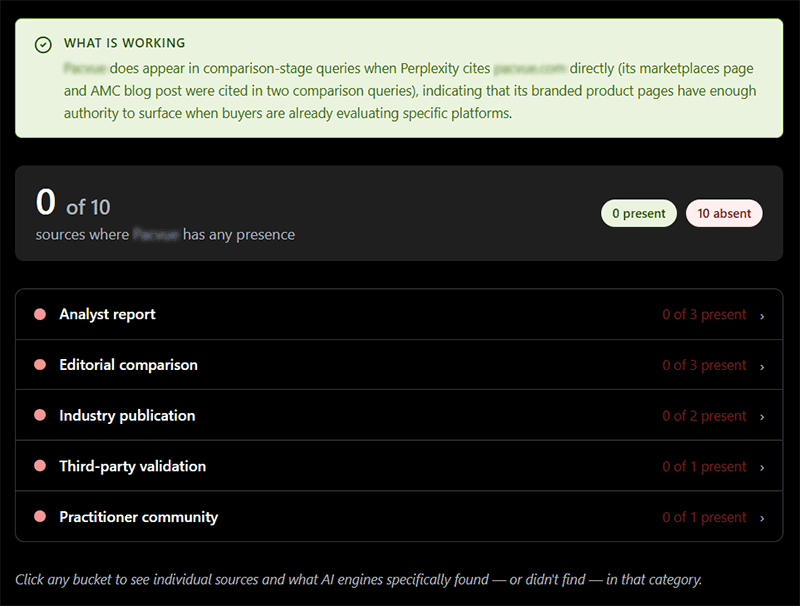
The correlation is hard to ignore. Companies with little to no third-party signal presence in that training data score significantly lower on AI visibility. Companies with ample third-party citations score dramatically higher, even when their first-party content is comparable.
The model isn’t weighing your content in isolation. It’s weighing your content against everything else it’s seen about you.
Building the First-Party Layer
The goal for first-party evidence isn’t volume. It’s attribution density.
Definition
Attribution Density
The degree to which a consistent, specific claim appears across enough first-party touchpoints that AI systems build a stable, reproducible association with your company. Volume matters less than consistency of framing. The model needs to encounter the same claim, anchored to the same source, enough times to treat it as a reliable signal.
A few things that move the needle:
1. Name your IP.
Generic content competes on volume. Your branded products/services, named frameworks, coined terminology, and proprietary methodologies give AI systems something to attribute.
When the same named concept appears across multiple pieces of content with consistent framing, the model builds confidence in that attribution. This is why “Problem Ownership” as a named concept shows up in AI responses about B2B AEO strategy. The name gives the model a handle.
2. Create structured answer content.
AI systems extract structured, quotable claims more reliably than prose buried in long-form content. Definition blocks, FAQ sections, and clearly labeled summary statements aren’t just UX improvements. They’re signals that tell the model exactly what claim the content is making and who is making it.
3. Publish consistently on the same problem.
A single post on a topic will be noted. A consistent body of work with linked internal references and compounding depth creates the topical density that can’t be ignored. Sporadic coverage doesn’t build the same association.
4. Be specific about the problem.
“We help B2B companies with marketing” is a worthless claim for the bots (and humans for that matter). Specificity at the problem level is a requirement for AI retrieval.
Something like “We help mid-market B2B companies identify what’s actually holding back growth so they can start building a more predictable revenue engine” is a much more specific claim.
The more precisely you name the problem, the more precisely the model can match it to how buyers actually describe their situation.
Building the Third-Party Layer
Third-party evidence requires a different posture. You can’t publish your way to it. You earn it, ask for it, and create the conditions for it.
1. Customer reviews are underutilized AI signals.
G2, Capterra, and similar third-party review platforms are indexed and cited by AI systems. Every review that describes a specific outcome, using natural problem language, is a third-party receipt. It confirms for AI that your company belongs in the answer when a buyer describes that same situation.
For decades, collecting reviews was about social proof and customer satisfaction. Now each one is a signal that strengthens AI’s conviction to recommend you.
2. Earned media on the right topics.
A podcast interview, contributed article, or media mention carries more corroborating weight than another post on your own blog because it comes from a third-party with no vested interest in promoting you.
The key variable is whether that external content connects you to the specific problem you’re trying to own. A generic brand mention doesn’t do much for you if the piece isn’t contextually aligned.
3. Customer and employee voices on LinkedIn.
When a customer describes their experience with your company using language that maps to the buyer problem you’re targeting, that content is indexed and retrievable.
This is why asking for specific, outcome-oriented recommendations matters beyond just immediate social proof. The language customers use when they describe how you solved their problem is ACTUAL “natural problem language” versus anything your marketing team would write.
The same applies to your own team. When employees consistently describe the problems you solve in their own posts and commentary, those are indexed signals too! And they reinforce the same association from a different direction.
4. Public proof that’s specific enough to be useful.
Vague case studies are one of the most common ways mid-market companies undermine their own third-party layer. “Helped a SaaS company improve pipeline” is not something AI can use to answer a buyer’s specific question. “Diagnosed an ICP alignment gap that was causing late-stage deal loss at a $20M B2B services firm” is.
The specificity is what makes the proof usable, both for a human buyer and for the AI helping them evaluate you.
The Connection to Ownable IP
My previous post last week also talked about how companies with named, published Ownable IP build Problem Ownership faster than companies competing on signal volume alone. The reason is now clearer.
Ownable IP creates a consistent, attributable framework that both evidence layers can reinforce. When your first-party content references a named methodology and external sources begin citing it, the model has a specific concept to anchor the attribution to. Generic positioning doesn’t create this anchor because there’s nothing to attribute. Named IP does.
For example, our Fathom360™ growth diagnostic, a structured GTM assessment methodology we developed, is owned IP. Now we’re selling it and creating content around it consistently. Then we get an article in Forbes that talks about it. That’s a earned win and a strong signal for AI.
This is why taking an IP inventory should be an early exercise for any serious AEO program. It’s not just a marketing differentiation question. It’s a structural question about what you’re giving AI systems to work with when a buyer (or the AI helping them) starts asking whether you’re safe to recommend.
What This Means Practically
Companies that treat AEO as an owned content tactic will see diminishing returns as the category gets more crowded. The models are looking for corroborated authority, and corroboration requires third-party receipts.
The companies that build durable Problem Ownership and win consistent recommendations will have done two things: built a clear, specific, consistent body of first-party content anchored to a named point of view, and systematically created the conditions for third-party sources to verify it.
Claiming ownership is the strategy. Proof is the execution. And the buying committee evaluating your proof is no longer entirely human.
If you want to understand where you stand across both layers, an AI360™ Snapshot is a perfect (and FREE) starting point. We’ll map your current evidence architecture and identify the highest-leverage gaps to start closing right away. Schedule an AI360 discovery session today.
Common Questions
Why does AI recommend some B2B vendors over others when a buyer describes a problem?
AI answer engines don’t retrieve a single authoritative source. They synthesize a probabilistic response from the aggregate weight of corroborating signals. A company gets recommended when enough independent sources, from enough distinct directions, point to that company as a credible answer for a specific buyer situation. Volume from a single source produces diminishing returns; corroboration across independent sources is what actually shifts the output.
What’s the difference between first-party and third-party evidence for AI visibility?
First-party evidence (the content your company publishes and controls) establishes a documented, attributable position on a buyer problem. Third-party evidence (reviews, earned media, external references) signals to the model that sources with no promotional stake in your company independently confirm you belong in the answer. Neither layer is sufficient alone: first-party without third-party is a self-asserted claim; third-party without a coherent first-party framework gives the model nothing to anchor the corroboration to.
