



Enterprise companies are on to something. We’ve started seeing a rapid influx of job postings for dedicated leadership roles in AEO (answer engine optimization) and GEO (generative engine optimization). Real budget, real reporting lines, director and VP-level titles.
The big boys see where this is going, and they understand both the elevation and the gravity of the role.
But how should mid-market B2B CEOs/owners be thinking about this?
Budgets are already tight. Marketing teams are already stretched. And there’s no shortage of misinformation about how to tackle the new scope that comes with improving AI visibility.
From my vantage point, you don’t need to make an AEO hiring decision yet.
We’ve been in the trenches doing this work over the past few months, and documenting our methodologies on this blog along the way. There are plenty of agencies, SEO shops and consultants ready to sell you a resourcing decision before they’ve told you what the job actually needs to cover at your size.
That’s backwards.
Enterprise isn’t funding AEO leadership because the acronym got hot. They’re funding it because they’ve already done the harder work of defining the scope of what the function owns.
Most mid-market B2B companies haven’t done that work yet, which makes hiring for it right now less of a strategic move and more of an expensive guess.
A Quick Rewind to Make Our Case
Back in April 2026, we mapped out why this new practice needs a leadership seat. AI visibility isn’t a new channel sitting next to your existing functions. It’s three layers of responsibility sitting on top of all of them, content, SEO, brand, product marketing, PR, customer advocacy, each already producing signal whether anyone’s managing it or not.
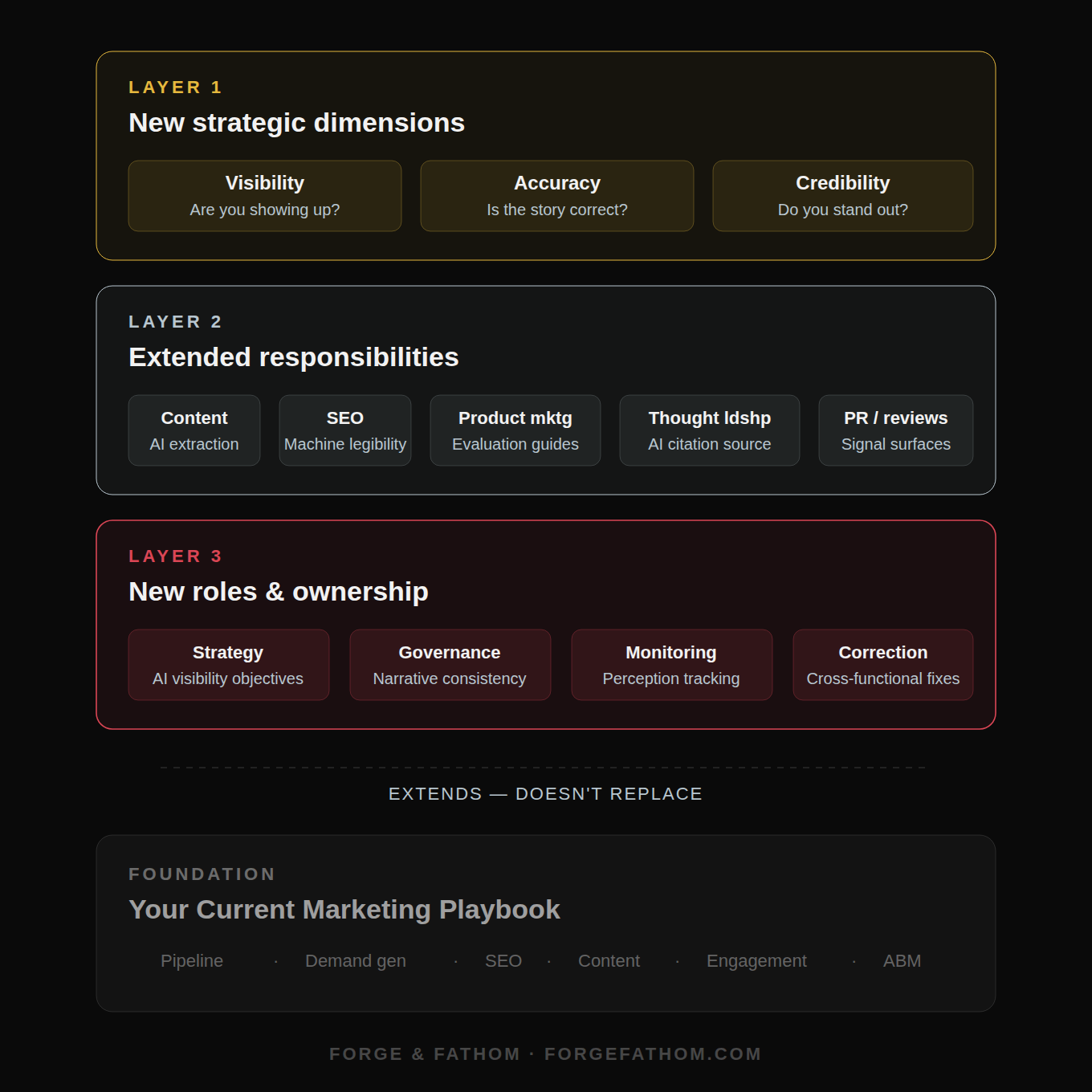
There are new strategic dimensions (visibility, accuracy, credibility), extended responsibilities across existing functions, and, critically, new roles for strategy, governance, monitoring, and correction. That third layer, the ownership layer, is what enterprise just started funding.
That’s exactly why a content manager or an SEO lead can’t just absorb this. They own one function’s slice of the signal. Nobody owns the tradeoffs across all of them, and those tradeoffs are the actual job.
The LLM-Era Marketing Playbook then went function by function to show what changes, and the pattern that came out of it wasn’t “everyone does a little more work.” It was “someone has to decide what each function stops doing so the signal stays coherent.”
Your SEO person can’t tell PR to stand down on a channel. Your content lead can’t reprioritize product marketing’s roadmap. Someone above all of them has to make that call, which is a sequencing decision, not an execution task.
By June 2026, in Your Content Strategy Has Expired, we sharpened the stakes. Most B2B teams can’t build deep, corroborated evidence on every problem they could plausibly cover, so they have to choose a handful of buyer problems and go deep on those.
Choosing which problems to walk away from, and defending that choice across departments when everyone thinks their channel deserves the investment, is a leadership call.
Hand it to whoever’s already stretched thinnest on the team, and you get consensus by committee: a list too long to execute well, built by whoever argued loudest in the room.
That doesn’t require a full-time seat on day one, though. It requires someone accountable for the tradeoffs across functions, whether that’s an eventual hire or a partner who owns the strategy and sequencing in the meantime.
The role exists either way. The only real choice is who’s sitting in it while you figure out if it’s worth a permanent headcount line.
Bottom line… Q2’s job postings just proved us right, with real budget attached.
Enterprise Just Answered Who Owns AEO
Stripe is hiring an AEO & GEO Marketing Manager, base salary $143,400–$215,200.
Amazon Web Services has a dedicated Answer Engine Optimization Manager role inside its search marketing org.
These are standalone, senior, funded positions with their own scope, not SEO generalists picking up a new acronym.
Conductor’s CMO investment research puts a number on the direction: 94% of CMOs plan to increase AEO spending this year.
Why the Hire Can Wait
Most mid-market companies aren’t going to be able to justify a dedicated AEO hire yet. And that’s not a bad thing…the function hasn’t been scoped yet, so there’s nothing real to size a hire against.
If you’ve ever hired for a role prematurely, these stats will probably not surprise you:
- The U.S. Department of Labor puts the floor cost of a bad hire at 30% of first-year salary.
- SHRM’s range runs 50%–200% for specialized, senior roles (the exact profile Stripe and AWS are hiring into).
When applied to Stripe’s own posted range, the floor alone puts a wrong AEO hire north of $54,000 before onboarding, ramp, or six months of lost signal while the wrong person holds the seat.
That’s the price of guessing at scope instead of defining it first.
Bolting AI visibility onto an existing SEO retainer also skips that strategic scoping step. So does hiring reactively because a competitor just posted a new job description.
Both treat “who owns this” as a staffing question before it’s been answered as a scope question.
Quick rule of thumb: if a proposed AEO/GEO effort touches more than three buyer problems that need dedicated evidence built, or requires pulling more than one function off its current priorities to coordinate, waiting to fill the seat costs more than filling it fractionally. Below that threshold, it’s genuinely fine to wait.
The Altitude Enterprise Just Funded
Now I’m not questioning what role agencies and SEO shops play here. They do real execution work that is needed. But what enterprise companies just funded sits at a different altitude: sequencing, prioritization, cross-functional coordination across every channel AI actually pulls from.
That’s a governance layer above execution, not a fancier version of it. A mid-market B2B leader with real decision-making authority needs to understand which product/service offerings drive the most revenue and can make the judgement call to stop focusing on offerings that aren’t. This is what that governance layer is responsible for.
I also feel strongly that this won’t stay a distinct hire forever. Content marketing was once a specialized function bolted onto a website team, then got absorbed into what marketing directors are simply expected to run. AEO leadership is on the same path.
Eventually, understanding how AI systems evaluate and cite your business will just be table stakes for whoever holds the VP Marketing or CMO seat. The gap between now and then is exactly where this AEO hiring decision matters.
Scope Before Staffing
You don’t need to make the decision to hire, outsource, or absorb the work today. You need to know what the job covers at your size before you commit to any of them.
That’s what an AI360™ Strategy Session was designed to produce: the roadmap that tells you to build vs. outsource vs. hire, before you spend on any of them.
And once that scope is defined, you don’t have to staff it alone to act on it. Our AI360 Monthly Program puts us in that governance seat, owning strategy, execution oversight, and monitoring, while you decide when the role earns a permanent hire.
If you’d like to get started with our AI360 offerings, get a free AI visibility snapshot report today.
Common Questions
When should a mid-market B2B company hire a dedicated AEO lead instead of using an agency or absorbing the work internally?
Once the function’s scope is defined, not before. Define which buyer problems are worth building AI evidence for, who has the authority to reprioritize other functions around them, and what success looks like at your size. Do that first, and hiring, outsourcing, or absorbing becomes the choice that actually makes financial sense, not a guess.
